ROMM: The Muslim Marriage Registration Guide
Muslim marriages in Singapore are registered with ROMM under the Administration of Muslim Law Act. Both parties must be Muslim and generally at least 21, the bride's wali must consent, and the akad nikah is held before two male Muslim witnesses. The groom gives the bride a mas kahwin. For religious rulings, consult MUIS or a qualified Asatizah.
If both of you are Muslim, your marriage in Singapore is registered not with the civil Registry of Marriages but with the Registry of Muslim Marriages (ROMM), under the Administration of Muslim Law Act (AMLA). ROMM is administered under the Ministry of Culture, Community and Youth (MCCY). This guide walks through the official process and requirements. It is not a source of religious rulings — for those, speak to the Islamic Religious Council of Singapore (MUIS) or a qualified Asatizah.
Who can register with ROMM
To apply for a marriage with ROMM, both parties must:
- Both be Muslim. If either of you is a convert, you obtain a permanent conversion card from the Muslim Converts’ Association of Singapore (MCAS) for a conversion done in Singapore; for a conversion done overseas, provide the conversion documents and an endorsement letter from MUIS instead.
- Be at least 21. If either party is 18–20, both must complete the Marriage Preparation Programme and the younger party must obtain parental or guardian consent. Different, exceptional rules apply below 18 — contact ROMM.
- Be unmarried or legally free to marry. On the ordinary route, you cannot have an existing marriage or an existing application with ROM or ROMM, and any previous marriage must be legally dissolved. A currently married groom must instead use ROMM’s separate polygynous-marriage application, which a Kadi reviews and decides in person.
- Have the wali’s consent for the bride (see below).
The wali’s consent
A core requirement of a Muslim marriage is the consent of the bride’s wali (guardian). The wali is identified in a set order of priority:
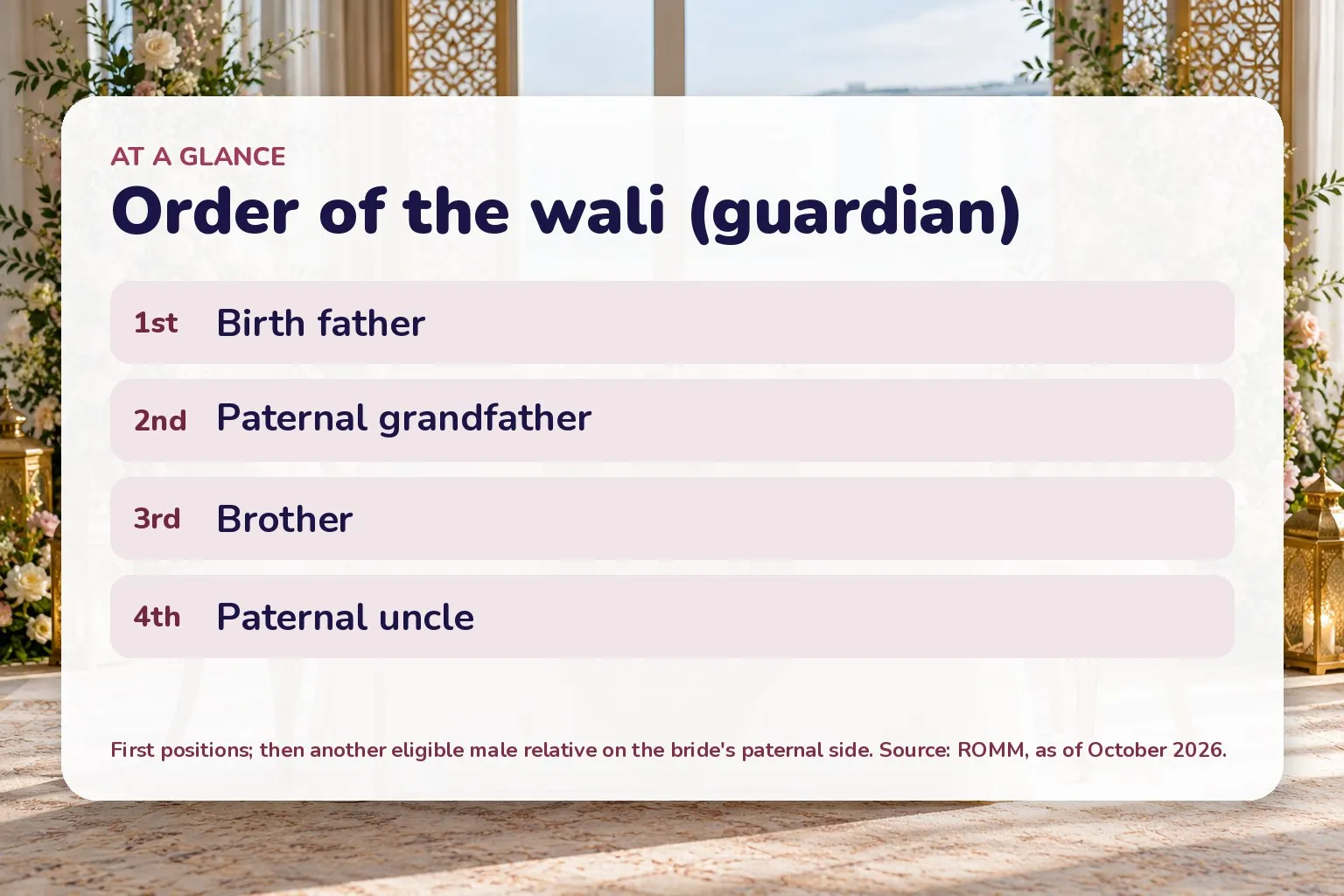
The wali is identified in this order of priority. Source: Registry of Muslim Marriages, as of October 2026.
- Birth father
- Paternal grandfather
- Brother
- Paternal uncle
- Then another eligible male relative on the bride’s paternal side (ROMM verifies eligibility)
If the wali is unavailable, ROMM has an authorisation and verification process. If there is no eligible wali, or a wali refuses consent on grounds a Kadi finds unsatisfactory, a Kadi (not a Naib Kadi) may solemnise after an inquiry. The wali is normally present during the solemnisation. Check with ROMM before making arrangements.
The akad nikah: solemnisation
The solemnisation ceremony is the akad nikah. The wali may conduct it himself, or authorise a Kadi or Naib Kadi (an Islamic registrar) to conduct it; a Kadi or Naib Kadi remains involved, and only a Kadi may solemnise without a wali in the circumstances AMLA allows. During the akad nikah the credentials of the couple and witnesses are checked, the bride’s consent is confirmed, and the groom gives the bride the mas kahwin (also called mahar) — ROMM sets a current minimum of S$100, in cash or a token such as jewellery (confirm the current amount with ROMM). Two male Muslim witnesses aged 21 or older are required. The ceremony may be held at a ROMM site or at an offsite venue of the couple’s choice — including a home or outdoor location — subject to the Kadi/Naib Kadi’s availability and any permission the venue requires; mosque arrangements are made with the mosque.
The cultural ceremonies that often surround the akad nikah — the hantaran, the bersanding and more — are explained neutrally in our Malay-Muslim wedding traditions guide. The mas kahwin (a religious obligation) and the hantaran (a customary gift) are two different things.
Documents to prepare
The exact list depends on your circumstances, but typically includes:
- NRICs or passports of the groom, bride, wali and two witnesses
- Permanent conversion card from MCAS for a convert (for an overseas conversion, the conversion documents and a MUIS endorsement letter instead)
- Documents for any previous marriage that has ended (divorce or death certificate)
- For Malaysian, Indonesian or Bruneian citizens, a letter of no impediment from their local registry, dated within 90 days of the solemnisation
Check the current, complete checklist on the Our Marriage Journey portal for your situation before your appointment.
After registration
On registration, couples receive a digital marriage certificate (ROMM also issues a ceremonial certificate). During the Canning Rise redevelopment, ROMM solemnisations are held at the interim Esplanade Mall site alongside ROM, with a return to Canning Rise planned for 2029 — see solemnisation venues.
Where to go next
- Malay-Muslim wedding traditions, explained
- The civil ROM process, for comparison
- What a wedding costs in Singapore
For any religious question about your marriage, consult MUIS or a qualified Asatizah. This guide describes the official registration process only.
Sources
- Registering & Solemnising Your Marriage — Ministry of Social and Family Development (as of October 2026)
- Who can apply for a marriage with the Registry of Muslim Marriages? — Our Marriage Journey (Registry of Muslim Marriages) (as of October 2026)
- Muslim Marriage Process — Registry of Muslim Marriages, Singapore (as of October 2026)